Weekly digest
Week of 3 August 2026
41 papers collected from PubMed, last swept 2 August 2026.
Top 10
Ranked by study design, journal and study size.
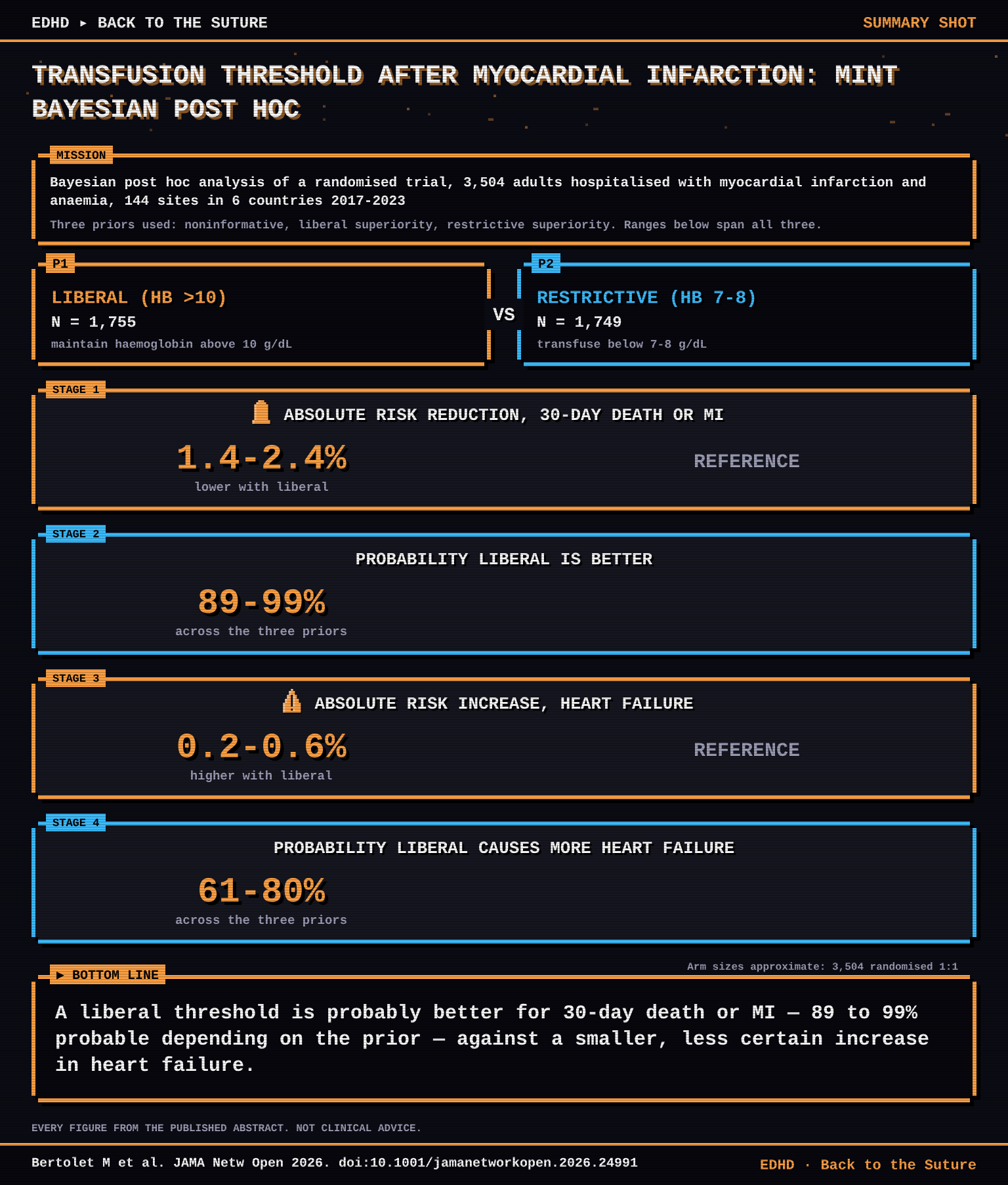
Restrictive vs Liberal Transfusion Strategy After Myocardial Infarction: A Post Hoc Analysis of the MINT Randomized Clinical Trial
Bayesian reanalysis of MINT finds high probability (89–99%) that a liberal transfusion strategy (Hb >10 g/dL) lowers 30-day death/MI in anemic MI patients, modestly outweighing a small increase in heart failure risk — supports liberal transfusion in this population.
STARDaki: a consensus-based STARD extension for standardized reporting of diagnostic accuracy in acute kidney injury
International consensus (17-item STARD extension) sets reporting standards for AKI biomarker diagnostic-accuracy studies, aiming to reduce the heterogeneity and contradictory findings that have plagued this literature.
Socioeconomic and geographic variation in response to trauma medical home intervention
Post hoc analysis of the multicenter Trauma Medical Home trial examines whether the coordinated post-discharge care model benefits rural and socioeconomically deprived injury survivors, informing how to target follow-up care equitably.
Benefits and Risks of Intensive Glucose Control in Intensive Care Units: A Meta-Analysis of Randomized Controlled Trials
Pooled RCT evidence weighing intensive versus liberal glucose targets in ICU patients; reinforces that tighter control raises hypoglycemia risk without a clear mortality benefit, supporting moderate glucose targets.
Intraoperative hemoadsorption and cardiac surgery-associated acute kidney injury: an updated systematic review and meta-analysis with trial sequential analysis
Across 15 RCTs, intraoperative hemoadsorption did not significantly reduce cardiac surgery-associated AKI, mortality, or need for RRT (very low certainty; information size not reached) — no support for routine use pending larger trials.
Initial vascular access for neonatal resuscitation: a systematic review
No trials directly compared vascular access methods during neonatal resuscitation; very-low-certainty evidence indicates umbilical venous and intraosseous access are both feasible, with most complications reported for intraosseous devices — highlights a major evidence gap rather than establishing a preferred route.
Limb salvage versus primary amputation in severe lower extremity trauma: a systematic review and meta-analysis
For severe lower-limb trauma (Gustilo IIIB/IIIC or MESS ≥7), limb salvage and primary amputation give comparable long-term function and quality of life, but salvage carries markedly higher infection (2.5x), re-hospitalization and chronic-pain rates and a 22.7% secondary-amputation rate — supporting individualized, shared decision-making.
Navigating the antithrombotic challenge in hip-fracture care: A framework to avoid delays and optimise patient outcomes
A practical framework for anticoagulated hip-fracture patients that decouples the (looser) haemostatic threshold for surgery from the (stricter) threshold for neuraxial anaesthesia, and uses active reversal plus patient blood management to keep surgery within 24-48 h rather than passively waiting out drug clearance.
Bayesian analysis of the early cold stored platelet transfusion following severe injury randomized clinical trial
Bayesian reanalysis of the "negative" cold-stored platelet trauma RCT (24h mortality 5.9% vs 10.2%, frequentist p=0.28) found an ~89% posterior probability that early cold-stored platelet transfusion reduces 24-hour mortality in patients at risk of hemorrhagic shock — suggesting a likely benefit that a definitive phase III trial should confirm.
Acute pulmonary embolism: clinical and echocardiographic recognition of normotensive shock
The 2026 AHA/ACC PE guideline introduces "normotensive shock" — tissue hypoperfusion despite preserved blood pressure — as a pre-arrest state; bedside recognition should combine lactate, capillary refill, mottling, and critical-care echo of RV overload to flag patients for early treatment escalation.
By category
Consensus/Guideline3 papers
Consensus document on the management of patients with accidental hypothermia (SEDAR, SEMICYUC, SEMES)
First tri-society Spanish consensus on accidental hypothermia — 37 Delphi-based recommendations across the whole rescue chain (prehospital prevention, initial assessment, transport, polytrauma care, hospital rewarming, cardiac arrest and ECMO resuscitation), giving a standardized protocol backbone.
Singapore First Aid Guidelines 2026
Updated national first-aid standards adding guidance on pulse oximeters, bronchodilators, supplementary oxygen, repeat adrenaline in anaphylaxis, hypoglycemia correction, counterpressure maneuvers for presyncope, handling of amputated parts, exertional dehydration, and jellyfish stings.
[Guidelines for the management of traumatic brain injury in the maritime environment (2026 edition)]
New consensus guideline for early treatment and evacuation of TBI at sea, where imaging, monitoring, and evacuation windows are severely constrained; centers on reducing secondary brain injury via on-scene triage, tiered decision-making under limited imaging, platform-capability classification, minimum en-route monitoring, and maritime-specific risk management.
New Research21 papers
Prehospital resuscitative endovascular balloon occlusion of the aorta (REBOA) in patients with major trauma and cardiac arrest: a systematic review
Synthesis of prehospital/transport REBOA use shows mixed mid- to long-term survival and no firm consensus on indications; underscores that field REBOA remains investigational in traumatic arrest.
Effect of regional anesthesia timing on clinical outcomes in isolated flail chest: A nationwide analysis
In isolated flail chest, starting regional anesthesia within 24 h (vs later) was associated with fewer unplanned intubations and ICU admissions, shorter hospital/ICU stays and more routine discharges — supporting prioritizing early regional analgesia.
Cognitive Motor Dissociation in Disorders of Consciousness: An Individual Participant Data Meta-Analysis
IPD meta-analysis of 56 studies (1,248 patients) found covert consciousness (volitional brain responses without behavioral output) is common but varies by etiology — less detectable after anoxic or cerebrovascular injury than after TBI, and more common in minimally conscious state minus. Detection was independent of time since injury, task paradigm, and modality, arguing for standardized protocols in neuro-ICU prognostication.
Association between Preexisting Electrocardiographic Abnormalities and Shockable Initial Rhythm in Out-of-Hospital Cardiac Arrest
Danish registry linkage of >22,000 OHCA cases finds preexisting ECG abnormalities are associated with the initial arrest rhythm, hinting at identifiable pre-arrest risk signatures relevant to shockable-rhythm likelihood.
Incidence, outcomes, and temporal trends of pediatric in-hospital cardiac arrest in Japan: a nationwide study
Over 12 years of Japanese national data, pediatric in-hospital cardiac arrest incidence fell (1.03 to 0.86 per 1,000 admissions) while survival to discharge rose to ~30%; most hospitals manage only 1-2 cases/year, supporting arguments for regionalization and a dedicated national resuscitation registry.
Diagnostic accuracy of blast-induced traumatic brain injury: a systematic review and meta-analysis
Pooled diagnostic accuracy for primary blast TBI was high (sensitivity 0.93, specificity 0.90, AUC 0.96), but biomarker and neuroimaging tools are impractical in acute battlefield settings; VOMS-based vestibular/ocular screening and the structured BATL-2 instrument are better suited for front-line use.
Diagnostic and prognostic applications of machine learning in paediatric traumatic brain injury: a systematic review of single and multimodal approaches
ML/DL models (including transformers and gradient boosting) can outperform GCS-based tools for detecting injury and predicting outcomes in pediatric TBI, but heterogeneity and limited external validation keep them pre-clinical.
Platelet Storage Quality, Plasticizer Migration, and Transfusion Exposure Risk in DEHP Versus Non-DEHP Blood Storage Systems
Systematic review found platelet quality (pH, aggregation, metabolism) is preserved in DEHP-free plasticizer systems while DEHP leaches far more than alternatives, raising modeled recipient exposure especially in neonates/pediatrics — supports the ongoing transition to phthalate-free blood collection and storage without compromising transfusion performance.
The Impact of Time-to-Intervention on Mortality and Functional Outcome in Acute Subdural Hematoma: A Systematic Review and Meta-Analysis
Pooling 6 studies (926 patients), no significant link between time-to-surgery and mortality or function in acute subdural hematoma — the classic "4-hour rule" is confounded by indication (sicker patients get operated faster), not evidence that speed lacks benefit.
An exponential increase in e-bike injuries in California
California e-bike injuries rose from 2 (2018) to 1,566 (2024) with more moderate-to-severe injuries than traditional bicycles and a mortality divergence emerging in 2024 — a rapidly growing, younger-skewing trauma burden that calls for targeted prevention and regulation.
Machine learning for prehospital prediction of trauma-induced coagulopathy: a national evaluation of the potential impact on tranexamic acid administration
A Bayesian-network ML model risk-stratifies trauma-induced coagulopathy early after injury; in this national cohort 75% of patients at medium-or-higher TIC risk did NOT receive TXA within 1 h — suggesting ML triage could direct earlier, more targeted TXA to those most likely to benefit.
Patterns in withdrawal of life-sustaining treatment in trauma patients with and without moderate to severe traumatic brain injury: an ACS-TQIP retrospective cohort study
Withdrawal of life-sustaining treatment occurs earlier in moderate-to-severe TBI than in other trauma and is driven by distinct neuro-specific factors (diffuse axonal injury, decompressive surgery, ICP monitoring); accumulating complications — the first four mattering most — may serve as practical triggers for goals-of-care discussions.
Renal impairment after burn-associated shock
In a large global-network cohort, burn patients who developed shock within 7 days had markedly higher acute kidney injury (RR 1.65), renal replacement therapy (RR 4.42) and mortality (RR 2.60 at 3 months) than matched non-shock burn patients, with elevated 1-year RRT and death persisting — supports intensified renal surveillance and kidney-protective strategies after burn shock.
Abdominal trauma and laparotomy in wartime civilian and military casualties: A National Registry Study
Among modern-warfare casualties, ~1 in 4 abdominal-trauma patients required laparotomy; small-bowel, colon, liver and retroperitoneal injuries plus higher injury severity independently predicted operation, yet in-hospital mortality stayed relatively low — data to guide triage in military and civilian trauma systems.
Fracture orthopedic risk of non-home discharge score II (FORD-II)
A 16-variable, admission-time score derived from the National Trauma Data Bank predicts non-home discharge after adult fracture trauma with strong discrimination (AUC 0.83), outperforming prior tools and potentially enabling earlier discharge planning; needs external validation outside the US.
Neuroprognostication after cardiac arrest in patients without withdrawal of life-sustaining therapy: a prospective observational multicenter study
In comatose post-arrest patients in whom life support was NOT withdrawn (minimizing self-fulfilling-prophecy bias), having >=2 unfavorable guideline-recommended markers within 14 days predicted poor 12-month outcome with zero false positives (adjusted OR 34.7); adding the Coma Recovery Scale-Revised improved discrimination — supports repeated, multimodal prognostication.
National Characteristics of Emergency Medical Services in Rural and Frontier Areas: A 2024 Update on Rural-Urban Differences in EMS Care
Updated 2024 NEMSIS analysis quantifies persistent rural-urban gaps in EMS response, clinical care, and on-scene mortality—evidence that geographic disparities in prehospital trauma care remain largely unclosed since 2012.
Occupational and sociodemographic inequalities in fire, heat and hot substance-related injuries among working-age adults: A Global Burden of Disease 2021 analysis
Global rates of fire/heat/hot-substance injury in adults 20-54 fell from 1990-2021, but large inequalities persist: occupational injuries drive ~24% of deaths/DALYs mainly in low/middle-income regions, while burn-care system gaps continue to cause excess mortality in low-SDI settings — a case for region-specific prevention and system investment.
Evacuation of hemothorax during SSRF: Does the technique influence the outcome?
In patients undergoing surgical stabilization of rib fractures with a hemothorax, VATS washout gave shorter chest-tube duration than blind intra-operative pleural irrigation (independent after adjustment), but mortality, pneumonia, readmission, and ICU stay were comparable — technique choice affects tube days more than broader outcomes.
2026 Donald Trunkey Lecture: strengthening care for the injured globally: successes, challenges, opportunities
Trauma kills 4.5M people/year with 84% of deaths in low/middle-income countries; over 1M deaths could be averted annually if LMIC case-fatality matched high-income levels. Long-term priorities are more blood availability, better TBI care, and improved prehospital care; immediate opportunities include trauma short courses, QI programs, an international trauma registry for benchmarking, and IATSIC-based needs assessments.
Comprehensive portrait of the needs of caregivers of individuals living with a traumatic brain injury: a systematic mixed-methods review
Synthesis of 32 studies identifies the main unmet needs of caregivers of people with moderate-to-severe TBI — information, mental-health support, hope, financial assistance, education of the social network, and peer support — to guide targeted caregiver-support interventions.
Clinical Pearl7 papers
Intracranial pressure physiology, monitoring and individualized management in the acute brain injured patient
Authoritative ICM review argues for moving beyond fixed ICP thresholds toward individualized, multimodal-guided management in TBI and other acute brain injury—reframing how ICP data should drive bedside decisions.
Low incidence of severe cardiac complications in traumatic sternal fractures: Rethinking routine rhythm monitoring
Severe cardiac complications after isolated sternal fracture were rare, challenging blanket telemetry/rhythm-monitoring protocols for blunt cardiac injury and supporting a more selective monitoring approach.
Riding the shockwave: Escalating spine injuries from electric micromobility devices in the United States
US emergency-department spine injuries from e-scooters, e-bikes, and hoverboards rose ~8.4-fold over a decade (mostly fractures, predominantly in adult males) — a fast-growing trauma burden that warrants clinical anticipation and prevention/counseling efforts.
Characteristics and temporal trends of mobility scooter accidents in the Netherlands: a multicenter cohort study
Over a decade, moderate-plus (MAIS2+) mobility-scooter injuries rose 38% (91% in ages 70-79), with rollover the commonest mechanism and traumatic brain injuries more than doubling (+103%); ~30% required admission — a growing elderly trauma burden warranting targeted prevention.
Elevated risk of wound and systemic complications in MRSA-colonized patients undergoing lower extremity orthopedic trauma surgery
In matched cohorts (1,868 MRSA+ vs controls), preoperative MRSA colonization roughly doubled-to-tripled odds of sepsis, pneumonia, VTE, wound dehiscence, and transfusion after lower-extremity ortho trauma surgery — supports preop MRSA screening for risk stratification and possible decolonization.
Diagnostic evaluation of delayed flexion-extension radiographs after blunt cervical spine trauma: A prospective study
In alert patients with neck pain but normal exam and normal static CT, delayed flexion-extension films identified no surgically relevant unstable injury—arguing against routine use and for CT-based clearance instead.
Evaluation framework for assessing the quality and safety of artificial intelligence solutions for the acute care surgeon (EAST narrative review)
An EAST committee provides a practical framework for acute-care surgeons to evaluate AI/large-language-model tools — covering bias, validation, implementation, and governance — as these products proliferate in the ED, OR, and ICU.