Weekly digest
Week of 27 July 2026
34 papers collected from PubMed, last swept 27 July 2026.
Top 10
Ranked by study design, journal and study size.
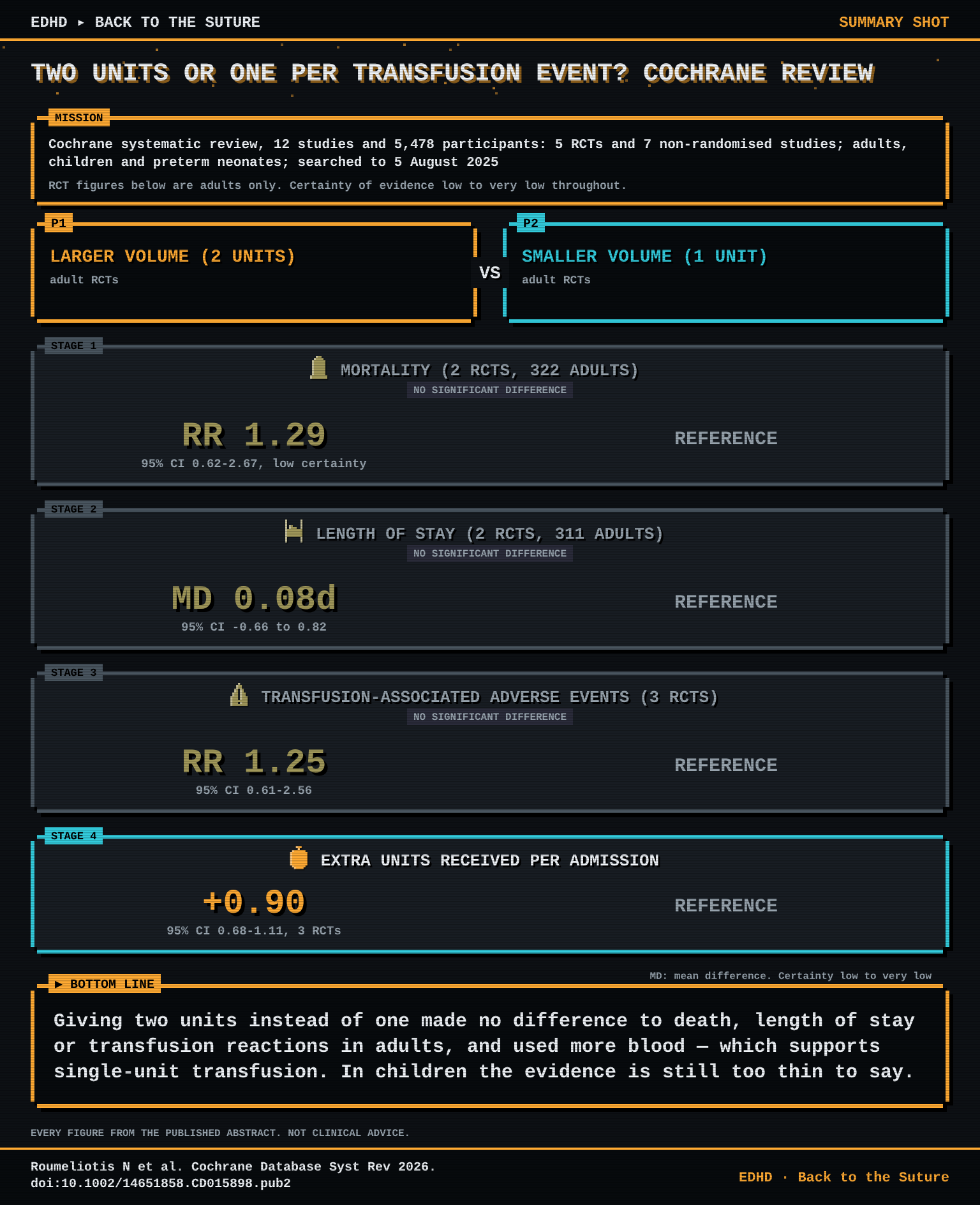
Larger versus smaller red blood cell volume per transfusion in hospitalized adults, children and preterm neonates
Cochrane review of RBC volume per transfusion event — an area with minimal prior evidence despite "single-unit" Choosing Wisely guidance. Highlights that per-event transfusion volume practice (including in pediatrics/neonates) rests on sparse, low-certainty data, with no firm signal that a particular volume strategy improves mortality.
Trauma stabilization points in armed conflict: operational evolution and strategic reflections from Mosul to Gaza
WHO Technical Working Group operational guidance for Trauma Stabilization Points (TSPs) — forward posts delivering life-saving care near the point of injury when evacuation is disrupted. Draws on field experience incl. three Gaza TSPs managing >4,000 consultations; informs standardization of forward trauma systems in conflict/disaster settings.
Sodium bicarbonate therapy in severe metabolic acidemia: an individual patient data meta-analysis of the BICAR-ICU and BICAR-ICU2 trials
Bicarbonate did not reduce 90-day mortality overall but cut renal replacement therapy initiation from 50.7% to 34.8% (NNT 6.3), and in the pH ≤7.10 subgroup it reduced 90-day mortality (RR 0.80) — arguing for earlier correction of profound acidemia.
Hemoperfusion during extracorporeal membrane oxygenation: an updated systematic review and meta-analysis of 8,151 patients
Adding hemoperfusion to ECMO did not reduce all-cause mortality, and within the three RCTs it was associated with higher mortality (OR 4.96) — current evidence does not support routine cytokine adsorption on ECMO.
Intraoperative hemoadsorption and cardiac surgery-associated acute kidney injury: an updated systematic review and meta-analysis with trial sequential analysis
Updated meta-analysis with trial sequential analysis of RCTs testing intraoperative hemoadsorption to prevent cardiac surgery-associated AKI after cardiopulmonary bypass; adds pooled evidence to a debated adjunctive therapy.
The usual suspects: a pragmatic framework to identify and address reversible contributors in apparent refractory septic shock
Before labelling septic shock refractory, run a parallel bedside sweep for reversible contributors — antimicrobial adequacy and source control first, then fluid responsiveness/tolerance, acidemia and sedation burden, and cardiac mechanisms including ventriculo-arterial uncoupling and dynamic LVOT obstruction.
Post-Transfusion Management of RhD-Negative Females of Childbearing Potential Who Receive RhD-Positive Low-Titer Group O Whole Blood During Trauma Resuscitation: Joint Position Statement (ACS-COT, PBTC, NAEMSP, THOR, Allo Hope Foundation)
RhD-positive whole blood/RBCs should not be withheld from RhD-negative females of childbearing potential when RhD-negative units are unavailable and transfusion is clinically indicated — immediate survival outweighs future reproductive risk (modeled perinatal-death risk ~0.04%; any HDFN-complicated future pregnancy ~0.6–6.5%). Recommends selective Rh immunoglobulin prophylaxis for low-volume exposures, structured antibody surveillance, counseling, multidisciplinary follow-up, and institutional protocols; also flags an equity gap — women are ~40% less likely than comparable men to receive whole blood.
[Mild Traumatic Brain Injury: National Consensus Clinical Recommendations]
Portuguese national consensus proposes a decision algorithm combining the Canadian CT Head Rule with serum GFAP/UCH-L1 to safely avoid head CT in GCS 14–15 patients within 12 hours of injury; negative biomarkers in moderate-risk patients permit discharge without CT, and patients ≥75 need repeat CT rather than repeat biomarkers because baseline levels are elevated.
The association between pancreatic enzyme serum concentrations and blunt pancreatic trauma: a systematic review
Across 4 studies (4,937 blunt abdominal trauma patients, 150 pancreatic injuries), amylase/lipase drawn <90 min post-injury had low sensitivity; delayed testing (>3 h), especially combined lipase + amylase, performed better (one study 85% sensitivity/100% specificity) — don't rely on early enzymes, repeat after 3–6 h to help decide on further imaging.
Interfacility variation in trauma care costs without differences in mortality: A national retrospective cohort study
Hospital-level effects explained 13% of the variation in trauma hospitalization costs but only 3% of mortality variation; high-cost centers treated higher-acuity patients and had longer LOS but no better risk-adjusted survival (aOR 1.02) — highlighting value/efficiency opportunities rather than a spend-outcome link.
By category
New Research12 papers
Evaluating CASS and BATSS scores for predicting laparotomy in blunt abdominal trauma: meta-analysis from low- and middle-income countries
Across 12 studies (2,148 patients), CASS pooled sensitivity 77.2%/specificity 90.6% and BATSS 57.9%/86.5%; neither score is adequate as a standalone tool, but CASS may help rule out intra-abdominal injury and BATSS may help rule in the need for imaging or laparotomy where CT is unavailable.
A multicenter retrospective evaluation of treatment variation in blunt traumatic pneumothorax: noninvasive treatment versus tube thoracostomy (CONSTRAIN-Retro)
Nearly half of blunt traumatic pneumothoraces were managed without a chest tube; variation was greatest at 15–50% size, where noninvasive management gave similar complication rates and length of stay despite a 29% secondary tube thoracostomy rate.
Immunocompromised patients with viral severe acute respiratory infection in intensive care: an Australia-wide, retrospective, observational study
Immunocompromised patients made up ~19% of critically ill viral SARI admissions and had nearly double the adjusted odds of in-hospital mortality (aOR 1.93) despite receiving more antivirals and corticosteroids.
Racial and Ethnic Differences in Bystander Cardiopulmonary Resuscitation for Opioid-Associated Out-of-Hospital Cardiac Arrests
Using national NEMSIS EMS data (2017–2025), documents racial/ethnic disparities in bystander CPR for opioid-associated OHCA — a target for community resuscitation and naloxone/CPR training efforts.
Prognostic value of automated pupillometry in traumatic brain injury: a systematic review and meta-analysis
Pooling 4–5 observational studies (~350–380 adults), abnormal quantitative pupillometry (NPi <3 or absent reflex) within 72 h of TBI was associated with higher in-hospital mortality (OR 1.84) and ~3.6× odds of poor 3–6 month functional outcome; supports the Neurological Pupil Index as a bedside prognostic tool, though heterogeneity is high and controlled validation is still needed.
Fracture Orthopedic Risk of Non-Home Discharge score II (FORD-II)
Admission-time score built and validated on the NTDB (2019–2024) to flag adult fracture-trauma patients likely to need post-acute placement, so discharge planning can start earlier and cut length of stay.
Prehospital pelvic binder use and transfusion requirements in patients with pelvic fractures: A nationwide propensity-matched cohort study
Among blunt pelvic-fracture patients (prehospital binder used in only 1.8%), binder use was not associated with lower 24-hour RBC transfusion volume or in-hospital mortality, but was associated with more pelvic angioembolization (33.0% vs 21.2%, OR 1.82) — suggesting binders shape or reflect downstream hemorrhage-control strategy rather than directly cutting transfusion needs.
Acute-on-chronic versus isolated acute subdural hematoma in complicated mild traumatic brain injury
Retrospective multicenter cohort (IMADIS teleradiology workflow, 103 French EDs, 2020–2022) characterizing acute-on-chronic SDH vs isolated acute SDH in mild TBI and their association with radiological mass-effect markers — aimed at sharpening imaging-based risk stratification in complicated mTBI.
Impact of a rib fracture treatment protocol: a propensity score matching analysis
A protocolized multimodal rib-fracture bundle (escalating analgesia, standardized nursing assessment, atelectasis/mucus-clearance regimen) was associated with shorter LOS (−1.4 days adjusted; 14.7→11.2 days matched), fewer rapid responses and lower odds of mechanical ventilation, and lower mortality in the matched high-morbidity sample (10.7%→6.5%) — despite only 53% protocol adherence.
Whole blood first resuscitation and association of blood product utilization based on mechanism of injury
In 1,013 transfused trauma patients (785 whole-blood-first), a WB-first strategy was associated with ~29% lower total 24-hour blood volume (ratio 0.71, 95% CI 0.55–0.90) with no significant effect modification by injury mechanism; the 30-day mortality estimate was non-significant and unstable (~30% missing labs).
Outcomes of anterior versus posterior rib fractures and surgical treatment: analysis of 249 patients
Prospective longitudinal cohort suggesting rib fracture location (anterior vs posterior) shapes recovery beyond fracture count/displacement alone — arguing that anatomic location should factor into chest-wall injury risk assessment and surgical decision-making.
Advanced Hemodynamic Monitoring During Post-Resuscitation Care After Out-of-Hospital Cardiac Arrest: A Scoping Review
Maps what advanced hemodynamic monitoring is used in early post-OHCA care and how targets are set; finds practices and treatment thresholds beyond routine arterial pressure remain poorly standardized.
Clinical Pearl12 papers
Acute pulmonary embolism: clinical and echocardiographic recognition of normotensive shock
Unpacks the 2026 AHA/ACC PE guideline's new "normotensive shock" state — tissue hypoperfusion despite normal blood pressure — and argues for integrating concordant clinical signs (not a single marker) to escalate treatment earlier.
Balanced crystalloids vs. 0.9% saline in pediatric diabetic ketoacidosis: a systematic review and meta-analysis of RCTs
SR-MA of RCTs comparing balanced crystalloids vs normal saline for pediatric DKA resuscitation (primary outcomes: time to DKA resolution, new AKI) — adds to the broader critical-care debate on avoiding hyperchloremic acidosis with balanced fluids.
To reverse or not to reverse: Direct oral anticoagulants in mild traumatic brain injury
In isolated mild TBI after ground-level falls, DOAC use was not associated with worse radiographic progression or outcomes, and pharmacologic reversal (4F-PCC or andexanet alfa) conferred no measurable benefit — supporting selective rather than routine reversal.
Assessing fluid responsiveness in mechanically ventilated patients with intra-abdominal hypertension: a two-center, prospective, observational study
Passive leg raise loses accuracy in intra-abdominal hypertension (AUROC 0.71 vs 0.96), producing 16 false negatives tied to a persistently negative CVP–IAP gradient; end-expiratory occlusion and the 100 mL mini-fluid challenge remained reliable and should be preferred when IAP ≥12 mmHg.
Prone positioning in ARDS
Prone positioning is now a core early component of lung-protective ventilation for intubated ARDS with P/F <150, working by reducing lung stress and strain rather than by oxygenation alone; awake proning still needs confirmation outside COVID.
Where Should We Compress? Ultrasound Identification of the Ideal Area of Maximal Compression for CPR
Transthoracic echo mapping suggests the guideline-recommended sternal compression point may not overlie the ideal area of maximal compression / LV outflow tract, questioning standard hand placement during CPR.
Management of carotid artery injuries: What you need to know
CTA has replaced angiography as first-line for stable patients; revascularization beats ligation for penetrating zone II injury, endovascular/hybrid approaches suit zones I and III, and blunt carotid injury is managed non-operatively with antithrombotic therapy started as early as feasible — agent, dose and duration remain unsettled.
Rhabdomyolysis: What you need to know
Practical trauma/acute-care review of rhabdomyolysis; there is still no universal definition or agreed CK threshold and management remains debated — emphasizes timely resuscitation, monitoring for evolving AKI, compartment syndrome and DIC, and recognizing patients who need urgent surgical intervention.
Deep-learning CT reconstruction improves image quality but not diagnostic accuracy for sacral fragility fractures: MRI remains essential
Deep-learning reconstruction improved perceived image quality and reader confidence but not sensitivity or specificity; CT still cannot exclude sacral fragility fracture, so MRI remains necessary when clinical suspicion persists after a negative CT.
Pressure-targeted neurocritical care at the bedside: the emerging role of transcranial Doppler
Review arguing that fixed cerebral perfusion pressure thresholds miss individual autoregulation; noninvasive bedside transcranial Doppler can help personalize perfusion-pressure targets in acute brain injury.
Twenty-five years of septic shock hemodynamic resuscitation trials: a conceptual perspective
Synthesis of 25 years of trials argues fixed, isolated hemodynamic/metabolic targets (e.g., early goal-directed therapy) have repeatedly failed to reproduce outcome benefits; the field is shifting toward physiology-guided, phenotype-driven resuscitation using reversible tests in short decision cycles and rapidly responsive signals such as capillary refill time (ANDROMEDA-SHOCK-1/2).
Trauma-induced coagulopathy in pediatric patients: an evidence-based approach
Pediatric trauma-induced coagulopathy protocol: limit crystalloid to ≤20 mL/kg then switch to blood components, transfuse on clinical signs rather than labs alone, use thromboelastography to guide products, run an MTP at 1:1–1:2 plasma:RBC (whole blood preferred when available), give TXA for severe hemorrhage, and add enoxaparin VTE prophylaxis after stabilization in selected older/pubertal low-bleeding-risk patients.