Weekly digest
Week of 20 July 2026
23 papers collected from PubMed, last swept 20 July 2026.
Top 10
Ranked by study design, journal and study size.
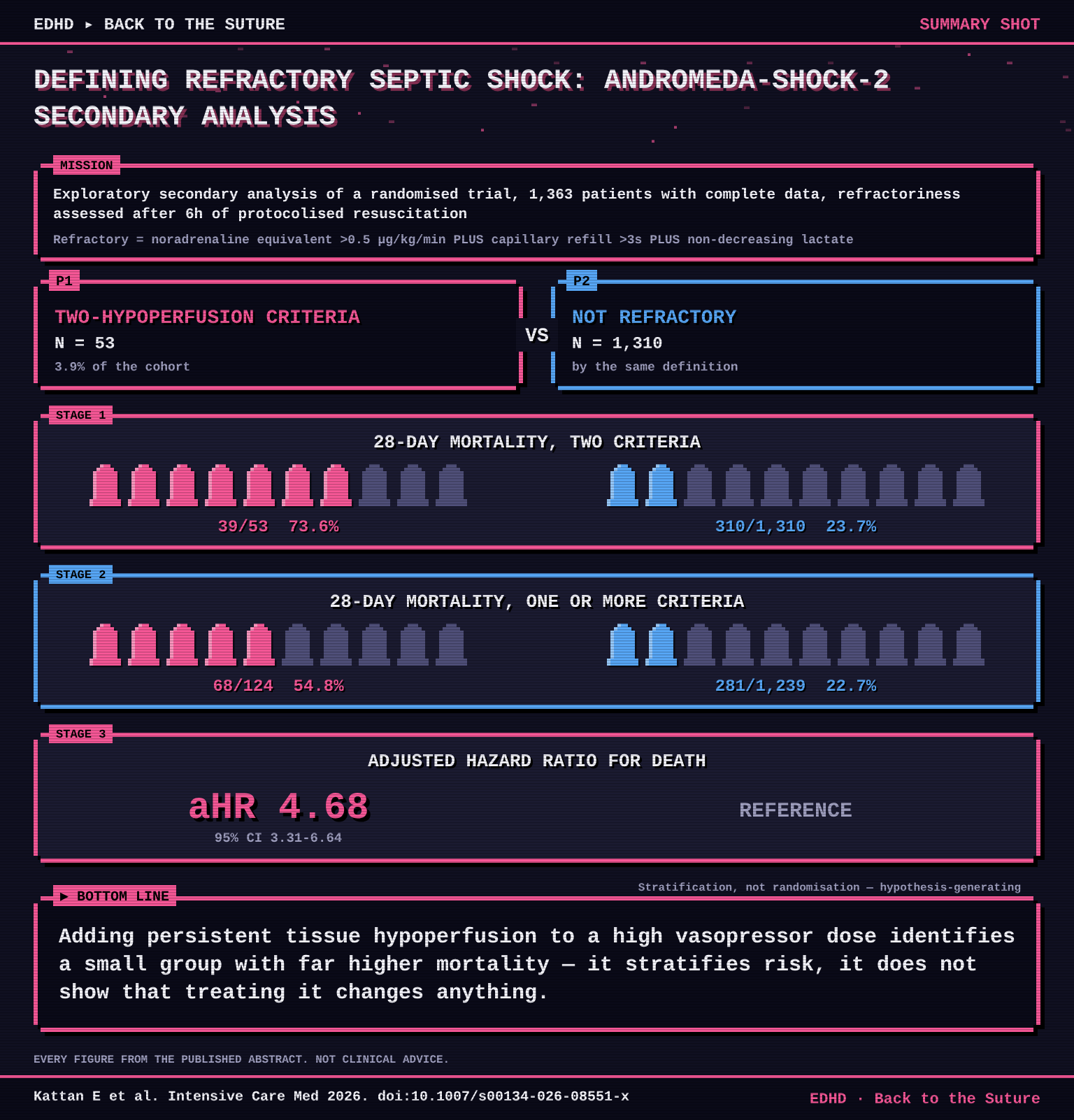
Persistent tissue hypoperfusion improves risk stratification beyond vasopressor dose in refractory septic shock: secondary analysis of ANDROMEDA-SHOCK-2
Adding persistent hypoperfusion markers (prolonged capillary refill + non-falling lactate) to a high vasopressor dose (>0.5 µg/kg/min NEE) identified a refractory septic shock subgroup with ~74% mortality — better prognostic enrichment than vasopressor dose alone.
Developing an EMS Research Reading List for EMS Practitioners
A Prehospital Guidelines Consortium expert panel curated 10 high-impact 2021–2023 primary EMS papers as a priority reading list, intended to bridge the lag between emerging evidence and formal prehospital evidence-based guidelines.
The usual suspects: a pragmatic framework to identify and address reversible contributors in apparent refractory septic shock
Before labeling septic shock refractory, run a parallel bedside sweep for reversible contributors — antimicrobial adequacy and source control first, then fluid responsiveness/tolerance, acidemia and sedation burden driving vasoplegia, and cardiac causes including ventriculo-arterial uncoupling and dynamic LVOT obstruction.
Ultra-low tidal volume ventilation and 1-year functional outcome in COVID-19 ARDS: long-term follow-up of the VT4COVID RCT
Ultra-low tidal volume (4 mL/kg) versus 6 mL/kg in COVID ARDS showed no mortality difference at 1 year but a small, significant decline in cognition (MoCA), possibly linked to higher PaCO₂ — a caution against permissive hypercapnia strategies.
Outcomes of surgical stabilization of rib fractures in COPD patients: A propensity-matched analysis stratified by injury pattern
In COPD patients with multiple rib fractures, SSRF showed no mortality benefit and more resource use versus nonoperative care, but early fixation (<72 h) was associated with shorter ICU/hospital stays and less ventilation in non-flail patients.
Venous thromboembolism in children with lower limb fractures: A systematic review and meta-analysis
Pooled VTE rate in children with lower-limb fractures was low (~0.53%); evidence on risk factors and prophylaxis efficacy is sparse, so individualized rather than routine pharmacologic thromboprophylaxis is recommended.
Hormone replacement before brain death increases organ donation rate after catastrophic brain injury: An EAST multicenter trial
Giving hormone replacement therapy to catastrophic-brain-injury patients before brain death was associated with significantly higher odds of organ donation; the methylprednisolone + levothyroxine combination had the greatest effect, supporting a standardized HRT protocol across trauma centers.
A multicenter retrospective evaluation of treatment variation in blunt traumatic pneumothorax: noninvasive treatment versus tube thoracostomy (CONSTRAIN-Retro)
Noninvasive management of medium-sized (15–50%) blunt traumatic pneumothorax gave similar length of stay and complication rates versus tube thoracostomy, supporting observation as a safe strategy where practice currently varies most.
Effect of goal-directed fluid resuscitation therapy based on peripheral perfusion index on acute skin failure in elderly critically ill patients: A randomized controlled trial
Adding a peripheral perfusion index target (PPI ≥1.4) to conventional macrohemodynamic resuscitation endpoints halved 7-day acute skin failure (14.6% vs 29.7%), improved 6-hour lactate clearance, and cut 72-hour positive fluid balance by ~600 mL; 28-day mortality was unchanged.
Intercostal nerve cryoablation in surgical stabilization of rib fractures: Does the benefit depend upon patient acuity?
Cryoablation during SSRF gave no opioid reduction in nonventilated patients and raised referrals for intercostal neuralgia (20% vs 4.5%), but in ventilated patients was associated with shorter ventilation (1.8 vs 5.3 days) and less pneumonia — argues for selective, acuity-driven rather than routine use.
By category
Consensus/Guideline1 paper
Key principles for rehabilitation of critically ill patients with obesity
Body composition phenotype matters more than BMI in ICU recovery — preserved muscle mass may protect, while visceral adiposity or sarcopenia predicts prolonged ventilation and ICU-acquired weakness; the panel calls for weight-rated mobilisation equipment, targeted nutrition, secretion clearance and positioning, and structured post-ICU follow-up.
New Research7 papers
Immunocompromised patients with viral severe acute respiratory infection in intensive care: an Australia-wide, retrospective, observational study
Immunocompromised patients made up ~1 in 5 ICU admissions for viral severe acute respiratory infection and carried nearly double the adjusted odds of in-hospital death (aOR 1.93) despite receiving more antivirals and corticosteroids.
Organizational models for acute gastrointestinal bleeding: a systematic review of hospital networks, multidisciplinary care and bloodless programs (2015-2025)
Evidence for how to organize acute GI bleeding services is very thin — multidisciplinary and transfusion-free (bloodless) programs showed promise, but hub-and-spoke network affiliation alone did not improve risk-adjusted mortality.
Differential association of prehospital physician presence with outcomes in out-of-hospital cardiac arrest: Secondary analysis of a nationwide registry
Prehospital physician attendance was associated with better 30-day neurological outcome (aOR 1.49), with the strongest signal in unwitnessed arrests and no benefit detected in patients who received ECPR — hypothesis-generating for how physician-staffed units should be dispatched.
Impact of vehicular data on trauma outcomes after motor vehicle crashes
Head-on and single-vehicle crash characteristics independently predicted severe injury (ISS>15), mortality, and need for surgery/ICU — arguing that vehicle/collision telemetry could sharpen prehospital field triage decisions.
Epidemiology and injury characteristics of pelvic ring injuries at a level 1 trauma centre: a 10-year retrospective cohort study
Across 1451 pelvic ring injuries, lateral compression patterns dominated (79%), a quarter met polytrauma criteria, 82% were managed non-operatively, and mortality was 1.4%. Useful contemporary denominator data for trauma-system and resource planning.
Deep-learning CT reconstruction improves image quality but not diagnostic accuracy for sacral fragility fractures: MRI remains essential
Deep-learning CT reconstruction raised reader confidence and image quality but did not improve sensitivity or specificity for sacral fragility fractures. A negative CT still cannot rule them out — MRI stays necessary when suspicion persists.
Emergency Medical Services Physician-Led Activation for Extracorporeal Cardiopulmonary Resuscitation in Out-of-Hospital Cardiac Arrest
Only 4.3% of non-traumatic OHCA patients met prehospital ECPR criteria; the physician-led activation protocol fired in 10 of 15 eligible patients, 5 were cannulated, and 4 of 10 survived to discharge with CPC 1 — feasible but very low-yield, needing multi-system study.
Clinical Pearl5 papers
Digital clinical decision support increases guideline-concordant care for elevated ICP in simulated TBI
A decision-tree CDS tool (BATDOK + TBI module) did not increase overall completion of critical actions in simulated en-route TBI care, but improved guideline-concordant tiered sequencing of ICP interventions and rated well on usability — early feasibility signal for en-route decision support.
To reverse or not to reverse: Direct oral anticoagulants in mild traumatic brain injury
In isolated mild TBI after ground-level falls, DOAC use was not associated with worse radiographic progression or outcomes, and pharmacologic reversal (4F-PCC or andexanet) offered no measurable benefit — supporting selective rather than routine reversal.
Assessing fluid responsiveness in mechanically ventilated patients with intra-abdominal hypertension: a two-center, prospective, observational study
Passive leg raise loses accuracy in intra-abdominal hypertension (AUROC 0.71 vs 0.96 without IAH), driven by a persistently negative CVP−IAP gradient producing false negatives; the end-expiratory occlusion test and 100 mL mini-fluid challenge stayed reliable and should be preferred in these patients.
Impact of MRI on the management of CT-defined AO Spine A/B thoracolumbar fractures
In 158 neurologically intact thoracolumbar trauma patients, adding emergency MRI to CT changed management in 12% — almost entirely by revealing posterior ligamentous complex injuries CT missed (48 vs 16 PLC injuries). Supports indication-driven, not routine, MRI.
Nonbeneficial Emergency General Surgery in Older Adults at Extreme Risk for Early Mortality
A Brigham trauma/acute-care-surgery group examines emergency general surgery that is likely nonbeneficial in older adults at extreme early-mortality risk — relevant to goals-of-care and operative decision-making in high-risk EGS. (Full abstract not available; verify details before podcast use.)